
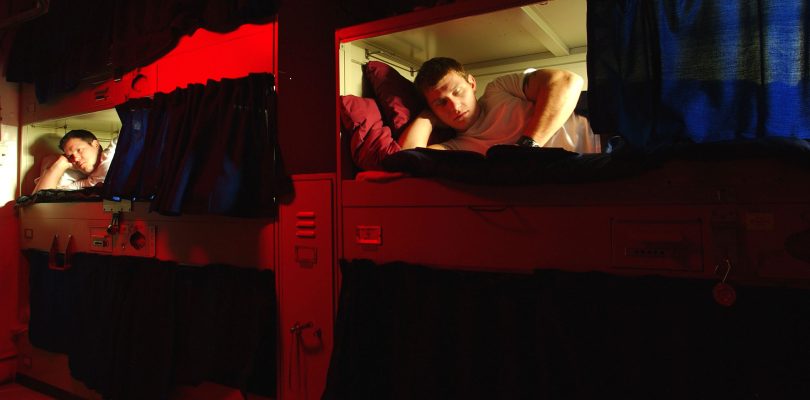
A new study drawn from survey data of nearly 16,000 sailors shows which jobs and ship classes report the best sleep and which have the most fatigue. It also appears to prove the value and impact of napping — a practice one researcher calls “micro-dosing” necessary crew rest.
The study, “Snoozing While Cruising: Nap Frequency as a Fatigue-Management Indicator and Risk Marker in Naval Operations,” was published in late July in the Journal of Sleep Research. It uses survey data drawn from the 2021-2024 Navy Afloat Climate Assessment Survey and includes sailors from amphibious ships, cruisers, destroyers, littoral combat ships and mine countermeasure vessels.
Aircraft carriers were not included, according to co-author Anne Germain, because of the logistics and timing of the study and availability of data.
Across all demographics, sailors reported napping an average of about 1.5 days per week and rated burnout levels 2.66 out of five. They rated job stress an alarming 3.77 out of five. Most reported that fatigue impacted or distracted them from job duties (3.34 out of five), and while sailors rated general health relatively well (2.75 out of five), they reported an average of nearly nine poor physical health days and about 14 poor mental health days per month.
While baseline levels of exhaustion and stress appear to be the norm, some ships fare worse than others.
Data show that littoral combat ships, with their small crews, report the highest level of burnout, rating an average of 2.7 out of five. Cruisers report the lowest burnout rates, averaging 2.62. Job stress is highest for MCM ships at 3.87 out of five, and lowest for amphibs, at 3.59.
Nap frequency also varies. Chances of napping are best on cruisers, which reported 1.61 naps per week, and lowest on MCM ships, with 1.27 naps. LCS vessels had the second-lowest napping average, at 1.32.
That matters, according to the study authors, because data indicate that napping could counteract the effects of otherwise poor sleep while underway.
“Napping frequency was associated with lower odds of high job stress and impaired functioning, a pattern consistent with the broader experimental and operational literature suggesting that naps may support acute fatigue management when sleep opportunities are constrained,” the authors found.
Naps may also, they found, be an indicator of burnout. Sailors who napped five or more days per week were more likely to report an above-average number of poor mental health days. In these cases, napping may be an indicator to leaders that they need to intervene to get sailors additional rest opportunities.

Germain, the study’s co-author and the founder and CEO of insomnia care center Noctem Health, told Military Times in an interview that napping may be an important stopgap for deployed sailors who don’t have the option of getting eight hours of sleep at a consistent time every night.
“We’re not solving it forever; we’re not eliminating the problem, because in the context, that’s not realistic,” she said. “What is realistic is that we can have these micro-doses of sleep, micro-doses of very targeted intervention to give kind of a push for the next 12 hours, or the next six hours.”
Across the survey population, sailors reported having 5.7 hours of sleep available per day while underway and being able to sleep about 5.4 hours. They reported needing an average of 7.7 hours to feel rested, meaning they incurred a nightly sleep debt of 2.3 hours on deployment.
Among ship classes, sailors on amphibious ships report the largest average sleep debt, 2.4 hours, while those on MCM vessels reported the smallest average, 2 hours.
Germain said she attributed the differences in burnout, stress and nap rates between ship classes to missions and requirements. She also noted that differences existed between job fields. Sailors in administrative jobs reported the most burnout, at 2.85 out of five, while engineers reported the most job stress, at 3.88 out of five. Deck sailors, who reported high burnout but relatively low job stress, got the most naps, reporting an average of 2.14 days per week.
Pay grade also makes a difference. Sailors in ranks E1-E3 reported the highest burnout levels, but the lowest job stress and the highest nap frequency, at more than two days per week. Officers and the top enlisted ranks reported the highest job stress and lowest nap frequency, but lower burnout levels.
Germain said rest and sleep quality involve not only the amount of sleep available, but also what work stressors sailors “bring with them” when they try to rest and when their job allows them to sleep.
This study, completed on behalf of the Navy by Germain and co-author Dale Russell, a former director of research for Naval Surface Forces, is part of a multi-year effort to understand how to optimize crew rest and minimize job impairment underway.
Two separate deadly collisions involving Navy destroyers in 2017 revealed the life-and-death impact of crew fatigue and launched a push to standardize crew rest with attention to natural circadian rhythms. An ongoing effort supplies sailors with wearable devices to track their rest and other vital signs — and potentially allow leaders to see when greater intervention is needed.
Germain said she hopes the Navy will be able to use the new survey data to advance understanding of rest and the value of naps as a helpful aid, rather than a replacement for solid nightly sleep,
Naps are “not a treatment,” she said. “It’s like, here’s a behavior that you can try to optimize your sleep or optimize your alertness … at the sailors’ level, what you can tell is that those micro-interventions can have an impact on the moment, to mitigate some of the challenges that they’re facing.”