
Editor’s Note: This article first appeared on The War Horse, an award-winning nonprofit news organization educating the public on military service. Subscribe to their newsletter.
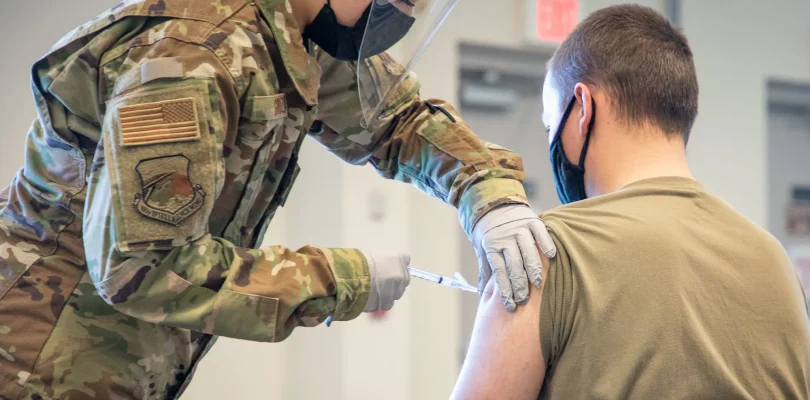
When the COVID-19 vaccine was released in 2020, Daniel Pendergast was intrigued.
“I honestly thought it sounded kind of ingenious at first,” he said.
But then he learned there was a very small chance of heart inflammation that could occur after vaccination in healthy men like himself: around eight cases per million, according to the U.S. Food and Drug Administration. For Pendergast, 44, whose family has a history of heart disease, even that low risk felt too high. He decided against taking the shot.
That was a problem for Pendergast. As a master sergeant in the Air National Guard, he was required to follow Pentagon orders mandating vaccination.
Ultimately, he decided to forgo vaccination and leave the military once his contract was up in June 2022. It was a hard decision. He had been in the military for 16 years, served in the Honor Guard, and sang the national anthem at sporting events.

“Lots of tears were shed over it,” he said. “It’s not something that I ever wanted to do.”
Now after four years as a civilian, Pendergast hopes to rejoin the military under a January 2025 executive order signed by President Donald Trump in his first month back in office. It promised to reinstate all service members who were discharged, or voluntarily left, for refusing the COVID vaccine. Not only does Pendergast want to continue to serve until his active duty retirement or beyond, but, he said, “I feel that we’re needed back in the force because we are the ones who held our integrity.”
The path to reinstatement hasn’t been easy. Pendergast submitted for reinstatement less than a week after Trump’s executive order. But that was almost a year and a half ago, and Pendergast still hasn’t put his uniform back on. Recently, the Board of Correction for Military Records offered him reinstatement and recommended he return to Active Guard Reserve status—though there’s no guarantee the Guard will honor that recommendation. He still hasn’t been offered a new contract.
Pendergast isn’t alone. The War Horse spoke with four military service members also vying for reinstatement after rejecting the COVID vaccine, and all complained about having to wade through bureaucratic red tape for months, despite being told by the White House they would be prioritized.
“A lot of people that are in the Pentagon or on the board, they didn’t live the abuse and the coercion that we did,” said Jordan Karr, a former Air Force intelligence officer who was involuntarily separated in 2022 for refusing the COVID vaccine. “We just want fairness.”
Thousands left the military during the COVID mandate
Nearly 8,000 active-duty and reserve troops were involuntarily separated after refusing to get the COVID vaccine, according to the Department of Defense. Of those, more than 4,000 did not receive honorable discharges. Many others, Pendergast included, left voluntarily when their contracts ended rather than take the shot. Just days before the January 2021 deadline, roughly 40,000 service members still hadn’t complied with the vaccine mandate, according to The Washington Post.
The effects of the vaccine mandate are still felt years later.
“I still have clients that are leaving today,” said Davis Younts, a lawyer and former Air Force judge advocate representing service members discharged after refusing the COVID vaccine. Younts said he represented three Navy SEALs who left as soon as their contracts were up.
“They spent two years on the sidelines, not able to train, not able to do anything, given horrible jobs,” he said.
Younts himself left the Air Force Reserve when his contract ended in 2022, opting to refuse the vaccine for religious reasons. He claims that vaccine deniers in the military generally fall into two camps: those opposed for religious reasons, and those who, like Pendergast, worried about the vaccine being experimental (according to the U.S. Food and Drug Administration, COVID vaccines were rigorously tested before receiving an emergency use authorization).
When Congress rescinded the military’s vaccine mandate in 2023, it should have been welcome news for the thousands of service members who had refused the shot. But only about 200 troops and 85 coast guardsmen have been reinstated so far, although nearly 900 have had their discharges upgraded. More than 800 of those discharged have expressed interest in returning to service, according to the Pentagon.
Since Trump’s return to office, the administration has made a concerted effort to win back more COVID vaccine deniers. Aside from the president’s executive order, which promised former service members a return to their prior rank and “full back pay,” Defense Secretary Pete Hegseth in early May created a COVID-19 Reinstatement and Reconciliation Task Force.
“We must continue to ensure there is a clear path for these service members to return to service,” Hegseth wrote in a memo announcing the initiative. “We will continue to make this right.”
Waiting months for reinstatement
Karr, the former Air Force intelligence officer, shared Pendergrast’s concerns about the COVID vaccine. She worried it could affect her ability to get pregnant, though the Centers for Disease Control and Prevention says there is currently no scientific evidence that COVID vaccines cause fertility problems. Karr asked for a medical exemption for a fertility disorder, but was denied. So she declined the vaccine and was involuntarily separated in 2022 with an honorable discharge. She also joined a lawsuit against the military, which was later dismissed.
Now she’s ready to rejoin, albeit this time in the reserves, since she now has a young infant. Karr submitted for reinstatement before Trump was inaugurated and was offered reinstatement 10 months later, but she has not yet accepted since she felt the terms were unfair.
“One of the things a lot of us have contention with is that we’re being offered to come back in the same position, which is actually a career negative for us,” Karr said.
Accepting the reinstatement offer meant she’d be four years behind peers who were vaccinated.
“People that sit behind a desk don’t understand the hardships that a lot of members went through,” she said. The Board of Correction for Military Records is still considering her appeal.
A former coast guardsman, who spoke on condition of anonymity out of fear speaking to the media might jeopardize their chances of reinstatement, said that after their vaccine refusal, the Coast Guard threatened a court-martial and nonjudicial punishment before settling on restricted leave, and eventually, an honorable discharge.
A year later, the Coast Guard came calling.
“I asked them, what were they offering?” said the guardsman, who declined their first offer as inadequate. “When you are being forced to get out, and a brand-new recruit is more incentivized to join than it is for you to be reinstated, it’s like a huge slap in the face.”
But after four years out of uniform, reinstatement is more appealing, though a lack of trust persists. The guardsman has been waiting about five months to rejoin the military.
“There’s still no accountability,” the service member said. “So the question is, if there’s nothing that says this won’t happen again, how do I know upon reinstatement that they won’t ruin my career again?”
A former Air Force service member, who also asked not to be named, said they have spent more than a year trying to return to the military. But the reinstatement process laid out by the Department of Defense and individual military branches seems to change by the day.
“It’s really been an onus on us to reach out, to pursue and advocate very heavily for ourselves,” the airman said.
Still, Hegseth’s COVID task force seems to be helping, they said. According to the airman, the officer in charge of the task force “is sincerely interested in fixing systemic issues with the current reinforcement process.” They have spoken several times about sticking points in the current process and brainstormed possible workarounds, the service member said.
Karr agrees. She thinks that Pentagon bureaucrats, rather than top leaders like Hegseth, have held up her case.
“He doesn’t have to keep putting out these messages saying that they want us back, but he’s doing it,” she said. “So I do believe that his heart is good.”
Back pay and missing bonuses
After Pendergast left the military in 2022, he was suddenly jobless for the first time in a decade. He took a job at a TSA help desk. Leaving the military came with a $34,000 pay cut.
“There were some lean years,” he said.
Daniel Pendergast had to quickly find a new job after leaving the military due to refusing the COVID vaccine (photo courtesy of Daniel Pendergast)
Some of the service members who spoke to The War Horse said they depleted their savings to stay afloat or relied on their spouses’ incomes.

So perhaps it’s no surprise the announcement of back pay in Trump’s executive order sparked excitement and controversy. But there was some fine print: Service members who are reinstated are subject to “offsets” that deduct any money made from civilian jobs or self-employment after their discharge, as well as payments from the Department of Veterans Affairs. It’s become a major deterrent for some people considering reinstatement.
“There are many military members who have side jobs, secondary jobs, second sources of income while they’re active duty, and none of that gets deducted from your paycheck,” said the former coast guardsman. The offsets, they said, are “something outdated that needs to be revised.”
The former airman described offsets as “a heck of a reality slap.” For people going through the full reinstatement process, some were “making zero money back for back pay,” they said.
Reinstated service members are also excluded from Trump’s tax-free “warrior dividend” of $1,776 paid to nearly 1.5 million troops last year, The War Horse has learned, despite language in the executive order saying reinstated troops receive their “full back pay, benefits, bonus payments, or compensation.”
When asked about delays in the reinstatement process and missing bonuses, Pentagon officials declined to answer The War Horse’s questions. Instead, they sent a July 14 statement from Anthony Tata, undersecretary of defense for personnel and readiness.
“The Department is fully committed to restoring honor and rebuilding trust with the warfighters impacted by the COVID-19 vaccine mandate,” the statement said, pointing to two recently released memos announcing a review into how the military planned and carried out the vaccine mandate between January 2020 and January 2023, and a directive to declassify that review. The review is expected to be made public by February 2027.
The military quietly releases a COVID vaccine study
At the same time the Trump administration is working hard to regain the trust of service members who didn’t get the vaccine, the Military Health System, which is operated by the Department of Defense, quietly released one of its largest reports to date about the safety of the COVID vaccine. The March 9 report, which was requested by Congress, found that service members who were vaccinated had a short-term risk of heart disease compared to those who were unvaccinated—though it was less than the heart disease risk of troops that were infected with the COVID virus.
The findings, according to Peter Chin-Hong, a professor of medicine at the University of California, San Francisco, who specializes in treating infectious diseases, are “similar to other studies where you know the risk is really in a short window period, and the risk is concentrated amongst young males in particular, and it’s not sustained.”
The study also found that some health conditions, such as acute kidney failure and hemorrhagic stroke, were less likely after service members were vaccinated. Those at risk for most of the health conditions studied were service members who contracted COVID and were not vaccinated, researchers said. In other words, the military study found the COVID vaccine protected most people from severe health conditions.
That wasn’t a surprise for Chin-Hong.
“Getting the real deal virus is much more detrimental to the body in multiple organs than the vaccine itself,” he said, noting that the virus and the vaccine activate the immune system in different ways.
When asked about the study, Pendergast said he hadn’t seen it and didn’t expect it to change his view.
“It doesn’t change the calculus for me,” he said. “This sounds a little bit like CYA.”
So why spend more than a year trying to rejoin the military whose explanation he doesn’t trust?
“We’re getting in either to restore our careers,” he said, “or a good percentage of us are getting in to try and restore the force itself.”


![CNRC Conducts an enlistment ceremony [Image 3 of 10]](https://www.navycrf.com/wp-content/uploads/2025/10/250w_q95-M6Ffyb-178x140.jpg)