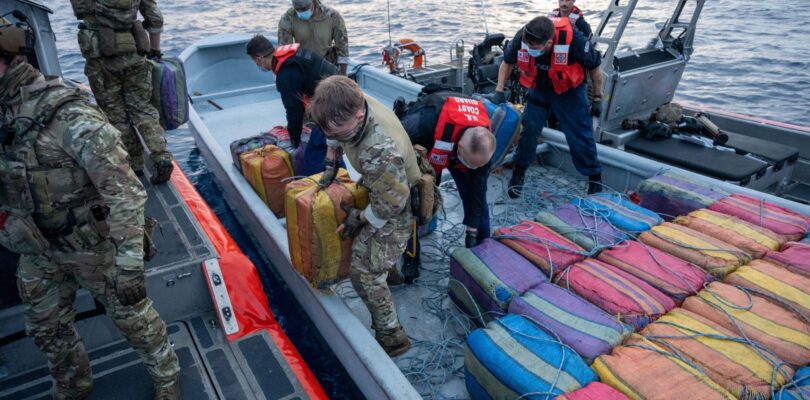
The U.S. Coast Guard didn’t meet its drug interdiction goals for 10 years, in part because it redirected a bulk of its efforts toward migrant interdiction at sea, an independent government watchdog found.
The Coast Guard failed to meet its metrics for drug interdiction efforts between 2015 and 2024 and missed its migrant interdiction goals for six of those years, despite funneling resources from drug seizure efforts to migrant interdiction, according to a Government Accountability Office report published Tuesday.
Part of the reshuffling of Coast Guard assets was due to limited resources, including the dwindling availability of vessels and aircraft, delays in acquiring replacement materiel and workforce shortages.
According to GAO, the target numbers for Coast Guard interdiction efforts were decided by Coast Guard performance measures, which the service now says did not accurately measure the success of its drug and migrant interdiction efforts.
In response to the inadequate performance measures, Coast Guard officials said that they had developed six new drug interdiction performance measures as of July 2025 that were already being used. The service was still in the early stages of identifying new migrant interdiction performance measures, however, at the same time.
The Coast Guard lowered its drug interdiction target three times over 10 years in an effort to make it easier to meet, but it still did not meet those targets, GAO said.
Several problems affected drug interdiction efforts, according to GAO.
For drug interdiction efforts, the Coast Guard relied on medium endurance cutters, but those vessels’ operational availability declined from fiscal 2020 to 2024 due to equipment failure.
The service also experienced issues acquiring new vessels and aircraft, due to lengthy wait times between requesting new materiel and receiving it, as well as problems with the affordability of new assets.
Adequately staffing billets was also an issue for the service, GAO found. Despite the service meeting its recruiting goals in fiscal 2024, from 2019 to 2023 it didn’t achieve its objective. As a result, the service was 2,600 service members short of its necessary workforce target at the end of 2024, according to the report.
When the Coast Guard began redirecting assets from drug interdiction efforts to address the maritime migration surge in 2022, many of these issues were compounded and became worse.
Lunday becomes US Coast Guard’s 28th commandant
The service faced the highest maritime migration levels it had seen in 30 years from fiscal 2022 to 2024, with nearly 70,000 migrants trying to come to the U.S. through the Caribbean Sea and Florida Straits, according to the report. Maritime migration averaged 8,200 migrants from fiscal 2015 to 2021, but increased to 34,000 migrants in fiscal 2022 and 2023, according to Coast Guard data cited by GAO.
From August 2022 to September 2024, the Coast Guard deployed 80 cutters in support of Operation Vigilant Sentry, which assists interdicting drugs and migrants in the Caribbean. Thirty-eight of those cutters were reassigned from other missions.
The Coast Guard deemed migrant interdiction a “life-saving mission” and a “higher-priority mission,” according to Coast Guard officials that spoke with GAO.
From fiscal 2021 to 2023, the Coast Guard increased operational hours for aircraft and vessels by 66% for migrant interdiction missions while decreasing operational hours for drug interdiction efforts by 62%.
During that time period, drug seizures halved. In 2021, the Coast Guard made 218 drug seizures, while in 2023 — when the migration surge was at a peak — the Coast Guard made 112 seizures.
The amount of drugs seized in that timeframe also decreased, with 143,000 kilograms being seized in 2021 and 110,000 kilograms being seized in 2023.
Drug interdiction performance was also thwarted by an uptick in the need for search-and-rescue missions and the fact that criminal organizations had become better at evading the service, the Coast Guard told GAO.
Despite the redirection of resources toward migrant interdiction efforts, it only met its performance measure targets for those efforts in fiscal 2016, 2017, 2022 and 2023. During that time span, the service lowered target numbers to make it easier to meet objectives, according to GAO.
Several other factors impeded migration interdiction efforts, including an increase in other countries conducting their own migrant interdiction missions, according to a Coast Guard fiscal 2024 performance report cited by GAO.
Coast Guard officials also said that sometimes the service would detect migrants but require the assistance of other agencies. Thus, even though the Coast Guard was an integral part of a particular interdiction mission, since it didn’t technically interdict the migrant, it didn’t statistically count in the service’s favor and hurt its ability to meet performance targets.
This is one of the reasons why the Coast Guard and its Office of Maritime Law Enforcement Policy were in the process of creating new performance measures to measure the success of migrant interdiction, according to the report.
GAO recommended that the commandant of the Coast Guard help invent new performance measures for migrant interdiction efforts and that the homeland security secretary ensures that the Operation Vigilant Sentry task force creates new ways to share lessons learned with other federal agencies.
![CNRC Speaks at Union League Club of Chicago Luncheon [Image 1 of 6]](https://www.navycrf.com/wp-content/uploads/2025/07/250w_q95-fz9eUl-178x140.jpg)