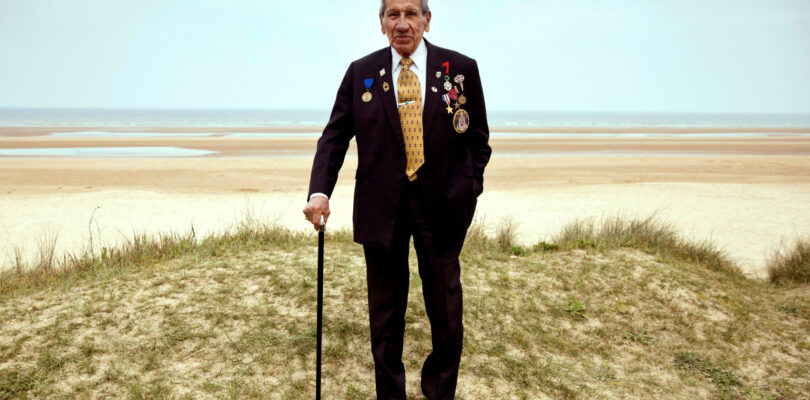
Charles Shay, a decorated Native American veteran who was a 19-year-old U.S. Army medic when he landed on Omaha Beach on D-Day and helped save lives, died on Wednesday. He was 101.
Shay died at his home in Bretteville-L’Orgueilleuse in France’s Normandy region, his longtime friend and carer Marie-Pascale Legrand said.
Shay, of the Penobscot tribe and from Indian Island in the U.S. state of Maine, was awarded the Silver Star for repeatedly plunging into the sea and carrying critically wounded soldiers to relative safety, saving them from drowning. He also received France’s highest award, the Legion of Honor, in 2007.
Shay had been living in France since 2018, not far from the shores of Normandy where nearly 160,000 troops from Britain, the U.S., Canada and other nations landed on D-Day on June 6, 1944. The Battle of Normandy hastened Germany’s defeat, which came less than a year later.
“He passed away peacefully surrounded by his loved ones,” Legrand told The Associated Press.
The Charles Shay Memorial group, which honors the memory of about 500 Native Americans who landed on the Normandy beaches, said in a statement posted on Facebook that “our hearts are deeply saddened as we share that our beloved Charles Norman Shay … has returned home to the Creator and the Spirit World.”
“He was an incredibly loving father, grandfather, father-in-law, and uncle, a hero to many, and an overall amazing human being,” the statement said. “Charles leaves a legacy of love, service, courage, spirit, duty and family that continues to shine brightly.”
Ready to give his life
On D-Day, 4,414 Allied troops lost their lives, 2,501 of them Americans. More than 5,000 were wounded. On the German side, several thousand were killed or wounded.
Shay survived.
“I guess I was prepared to give my life if I had to. Fortunately, I did not have to,” Shay said in a 2024 interview with The Associated Press.
“I had been given a job, and the way I looked at it, it was up to me to complete my job,” he recalled. “I did not have time to worry about my situation of being there and perhaps losing my life. There was no time for this.”
On that night, exhausted, he eventually fell asleep in a grove above the beach.
“When I woke up in the morning. It was like I was sleeping in a graveyard because there were dead Americans and Germans surrounding me,” he recalled. “I stayed there for not very long and I continued on my way.”
Shay then pursued his mission in Normandy for several weeks, rescuing those wounded, before heading with American troops to eastern France and Germany, where he was taken prisoner in March 1945 and liberated a few weeks later.
Spreading a message of peace
After World War II, Shay reenlisted in the military because the situation of Native Americans in his home state of Maine was too precarious due to poverty and discrimination.
Maine would not allow individuals living on Native American reservations to vote until 1954.
Shay continued to witness history — returning to combat as a medic during the Korean War, participating in U.S. nuclear testing in the Marshall Islands and later working at the International Atomic Energy Agency in Vienna, Austria.
For over 60 years, he did not talk about his WWII experience.
But he began attending D-Day commemorations in 2007 and in recent years, he has seized many occasions to give his powerful testimony and spread a message of peace.
During the COVID-19 pandemic in 2020-2021, Shay’s lone presence marked commemoration ceremonies as travel restrictions prevented other veterans or families of fallen soldiers from the U.S., Britain and other allied countries from making the trip to France
Sadness at seeing war back in Europe
For years, Shay used to perform a sage-burning ceremony, in homage to those who died, on a bluff overlooking Omaha Beach, where the monument bearing his name now stands.
On June 6, 2022, he handed over the remembrance task to another Native American, Julia Kelly, a Gulf War veteran from the Crow tribe. That was just over three months after Russia’s full-scale invasion of Ukraine in what was to become the worst war on the continent since 1945
Shay then expressed his sadness at seeing war back on the continent.
“Ukraine is a very sad situation. I feel sorry for the people there and I don’t know why this war had to come,” he said. “In 1944, I landed on these beaches and we thought we’d bring peace to the world. But it’s not possible.”